
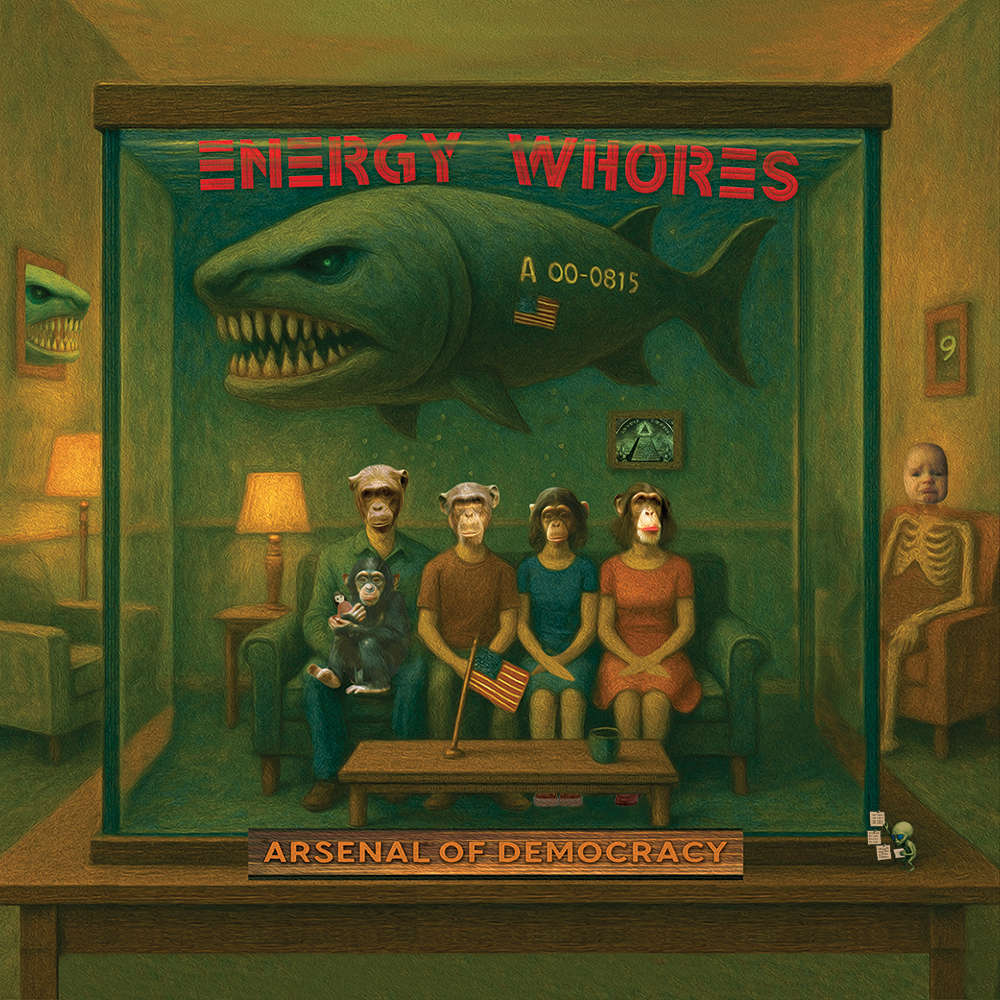
Energy Whores came out of New York’s DIY scene with one clear mission: make music about the things most pop artists won’t touch. While every other artist out there continues to sing about love or heartbreak, they’re writing about corruption, surveillance, and how the rich are buying bunkers while the rest of us can barely afford rent.

“They’re singing about the fire while others pretend the smoke is just fog.”
The album opener, “Hey Hey Hate”, is about how easily we’re manipulated into hating each other, how media, politicians, and algorithms feed us rage until we’re too busy fighting amongst ourselves to notice who’s actually, truly screwing us over. “Pretty Sparkly Things” follows a similar path, but by aiming at consumer culture and our collective obsession with buying our way to happiness. “Mach9ne” shifts into a more darker territory. It explores our growing dependence on AI and technology with a knowing cynicism.
“Bunker Man” continues the album by painting us a dystopic future of the ultra-wealthy retreating to their isolated fortresses while everything burns. The satire is biting! Energy Whores aren’t interested in both-sides-ing wealth inequality. They’re calling it what it is: moral bankruptcy dressed up as survival instinct. Then comes their track, “Two Minutes to Midnight,” and the album stops playing games. Nuclear war and all the actual possibility that we might not make it to 2050 anymore.
“Arsenal of Democracy” never loses sight of the human cost. Energy Whores are angry, for sure, but that’s not all it is. These songs are coming from people living through the same nightmare as the rest of us, without barely getting any time to process it all. There’s grief here, even sadness underneath the rage. The album truly understands that awareness is exhausting, that staying conscious of what’s happening takes a toll. But it also suggests that doing nothing isn’t the answer.
So, if you want something that actually engages with the world we’re living in, Energy Whores has made something worth your time. Stream “Arsenal of Democracy” because we need more artists who are willing to educate and use their platforms for the right reasons.
We also had a chance to do an interview with the artist and here’s how it went-
- “Two Minutes to Midnight” is genuinely unsettling. How do you approach writing about something as massive as nuclear annihilation without it becoming abstract or sensationalized?
A -I kept it personal on purpose. Nuclear war becomes abstract very quickly, and once it
does, it stops feeling real. I wasn’t interested in spectacle or big metaphors. I kept
asking myself a simple, uncomfortable question: what would you actually do if the sirens
sounded? You wouldn’t be heroic or poetic. You’d probably reach for someone you love,
freeze, or notice something painfully ordinary in the room. The song lives in those
seconds before panic, when denial hasn’t collapsed yet. That’s why the melody is gentle
and restrained. The horror isn’t the explosion, it’s the recognition and the expectation of
what’s about to happen. Staying close to the human scale was the only way to keep it
honest. - You maintain a DIY approach despite having the ability to polish everything. What would you lose if you went the traditional production route?
A-Honestly, the DIY approach was partly necessity. We didn’t always have the budget or
the hardware, and you work with what you have. If Spotify paid more than 0.003 cents a
stream, maybe that would help… ahem. That said, we’re actively polishing things now
because the songs actually gain power when they’re mixed and mastered properly.
Clarity matters. Space matters. Impact matters.
What I didn’t want to lose was control or intention. The most important things are the
lyrics, emotion, and musicality of a song. Proper mixing and mastering should be the
finishing touch, not something that smooths the meaning away. That’s where we’re
headed now. - A lot of protest music preaches to the choir. Who are you actually trying to reach with Arsenal of Democracy, the already-aware or the willfully ignorant?
A- I’m not trying to convert anyone. I’m speaking to people who already feel that something
is wrong but may not have language for it yet. The willfully ignorant usually aren’t
listening anyway. This album is for people who are paying attention, even if they’re
uncomfortable with what they see. I’m not offering answers. I’m offering recognition. - What’s been the most surprising reaction you’ve gotten from listeners so far? Has anyone completely misunderstood what you’re trying to say?
A-The most surprising reaction has been people saying the album made them feel calm.
Calm? I didn’t expect that at all. I think clarity can be grounding, even when the subject
matter is dark. A few people assumed I was being nihilistic, which is almost the opposite
of what I intended. Naming the problem isn’t pessimism. Pretending it isn’t there is. - If someone accused you of being too angry or too pessimistic on this album, what would you say to them?
A- I’d say anger can be a form of care. Indifference is what actually scares me. This album
isn’t driven by rage as much as concern and responsibility. I’m not interested in despair
for its own sake. I’m interested in lucidity. If that feels pessimistic, it might be because
optimism has been oversold for a very long time, like propaganda disguised as pretty,
sparkly objects meant to distract us from reality. That’s dangerous. Everyone needs to
escape sometimes, but the reality you escape to will eventually disappear, because it’s
an illusion. - You chose Arsenal of Democracy as the album title, a phrase historically tied to WWII production. What does that phrase mean in 2025, and why did it feel right for this collection of songs?
A- In 2026, the phrase feels deeply ironic. It once referred to industrial production in
service of democracy. Now we have enormous technological and informational power,
but it’s often turned inward and weaponized through propaganda, distraction, and fear.
For me, the arsenal isn’t weapons. It’s attention, responsibility, and the willingness to
stay awake. The title felt right because it asks what we’re actually building and who it’s
really serving.


Leave a Reply