

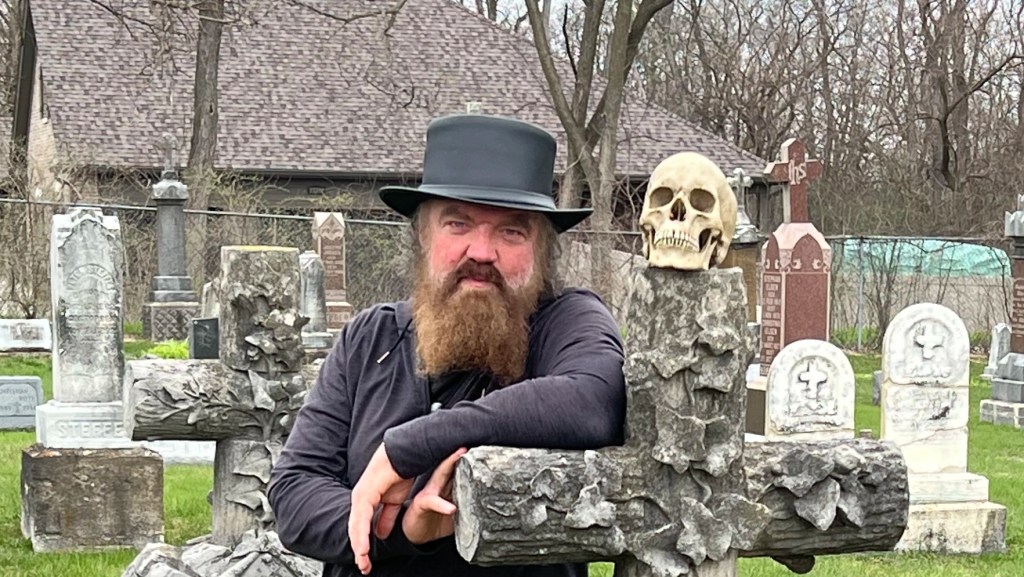
Rosetta West has never been about playing it safe. This Illinois-based collective, led by the enigmatic Joseph Demagore, has spent years kicking around the underground scene, steadfastly refusing to conform to the industry expectations or commercial pressures. They built a reputation for making music that defies easy categorization, putting together threads of blues, psychedelia, and world folk into something entirely their own. Rosetta’s approach has always been honest, spiritual, and deeply rooted in the kind of artistic realism that seems increasingly rare in today’s music scene.
“God of the Dead” is what happens when rock and roll sells its soul
to the crossroads and comes back with 26 stories to tell.”
“God of the Dead” represents the band at their most ambitious and unrestrained, a sprawling collection that abandons the focused brevity of their previous effort “Gravity Sessions,” in favor of something far more challenging. This latest EP showcases a group willing to follow their creative instincts wherever they lead, resulting in an album that feels purposeful.
Opening with raw blues rock that feels like it was recorded in a dusty Chicago basement, the record quickly pivots through punk aggression, funk rhythms, and gentle acoustic moments that reveal the band’s softer underbelly. Bassist Orpheus Jones and the dual drumming talents of Mike Weaver and Nathan Q. Scratch, provide a foundation to the overall album. The decision to rotate drummers throughout the album adds textural variety because each percussionist ends up bringing their own flavor to different songs. Guest contributions from bassist Louis Constant on “Midnight” and drummer Caden Cratch on “Boneyard Blues” become a testament to the band’s ability to maintain their identity while remaining open to outside influences.
Lyrically, the album ventures deep into mystical and spiritual territory, continuing the band’s deep dive into themes that go beyond the typical rock and roll genre. Demagore’s words often feel like incantations, drawing from ancient traditions and mythology in equal measure. The album’s hefty runtime might seem daunting, but it serves the material well. This isn’t a band trying on different styles for effect. These are multiple sides of the same artistic coin. Rosetta West has created an album that feels like a complete world unto itself. “God of the Dead” stands as proof that underground music continues to thrive, offering experiences that are usually unavailable through more mainstream channels.
For listeners looking for music that challenges as much as it entertains, “God of the Dead” delivers in abundance. It’s an album that reveals new layers with each listen. Rosetta West has created something truly special here.
Rosetta West took some time to talk with us, and here’s an excerpt:
Q- “God of the Dead” is a massive 26-track journey. That’s almost unheard of in today’s streaming world. What drove you to create something so expansive, and how do you hope listeners will experience it?
A- The streaming platform releases like Spotify have only 15 tracks, which is still extensive, but yes the Bandcamp extended version has much much more. I had new tracks and old tracks recorded, and I suppose I could have held some back for future release, but I’m not exactly young anymore and I wanted to make sure certain songs got out – just in case, ha ha. In terms of how listeners experience it, I hope it takes them on a journey to many places – like psychic geographical places. That’s what the best music does.
Q- The title “God of the Dead” is pretty heavy. What’s the story behind choosing that name, and how does it relate to the themes running through these 26 tracks?
A- I try not to be morbid, but a lot of my work tends to focus on existential themes, living on the edge of death, etc. Also, going back to the fact that there are some old songs on the album, it’s like the dead coming back to life after all these years
Q- For rock fans discovering Rosetta West for the first time through “God of the Dead,” which three tracks would you recommend as entry points, and why those particular songs?
A- That’s so hard to say, but the opener “Boneyard Blues,” would have to be one. It’s kind of a very minimalist manifesto of determination to keep going and keep striving through the suffering in life. “Morning Star,” on the Bandcamp only release is pretty essential because it’s an encapsulation of a very transcendent visionary period where songs seemed to be channeled directly to me, complete with music and lyrics. So hard to choose these…but “Baby Come Home,” is very beautiful and heartfelt. An old recording when I could sing my heart out, and did.
Q- Joseph, your lyrics dive deep into mystical and spiritual territory throughout the album. Are these themes drawn from personal experiences, specific traditions, or something else entirely?
A- Well, it’s very personal, but in my personal practice I drew on traditions of Western Magick. I was involved heavily in ritual magick for a relatively short time, but the repercussions and vibrations continue on, even now.
Q- You’ve maintained a fiercely independent underground career for years. What are the advantages and challenges of staying outside the mainstream music industry, especially when creating something as ambitious as this album?
A- Oh, I’m so glad not to be a part of the machine! I was like so many others – bitter at not being recognized and wishing to be let into the club, so to speak. Now I know I don’t need their fucking club. I’m better than them, and I take care of myself. I don’t need anything they have to offer.
Q- After years of crafting this unique blend of blues, psychedelia, and world folk, where do you see Rosetta West’s sound evolving next? Are there any musical territories you haven’t explored yet that you’re curious about?
A- Well, I just recorded a new song with a saxophone player. It’s called “Ear To The Ground,” and it will be out in September. I’m so thrilled because there’s never been a saxophone on a Rosetta West track, and also I play piano on it and I think I pushed my playing another level further. I’d love to keep expanding in terms of guest musicians. This was a good start. It was a great happy experience.
Catch A Muse Here:
Catch Similar Music in Our Rock Muse Playlist Here:
 Muse Chronicle
Leave a comment