

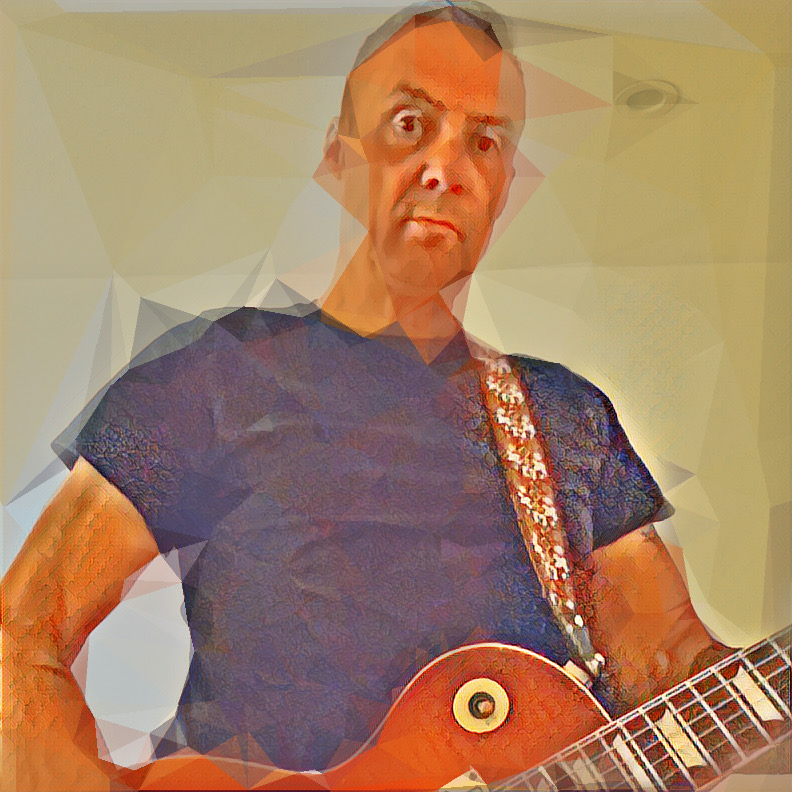
Following his previous work, “The Mind and Echoes,” Micheal Fordays took his time with this one. He even delayed the release to get the sound just right at Dave Klein’s revamped studio. It’s the kind of move that shows someone who values quality over speed, and it pays off big time. Fordays has clearly made peace with who he is as an artist, and that acceptance creates space for the kind of honesty that makes great albums such as “The Odds Of Magic.”
When you start trusting the process more than the outcome, that’s when the real magic happens.
The Los Angeles-based artist isn’t trying to be profound for the sake of it. Instead, he’s wrestling with real questions about existence, love, and what it all means. His process is beautifully simple. Just him, an unamplified Les Paul, and a blank piece of paper, waiting for inspiration to strike. He’s merely sharing his own journey and inviting you along for the ride. You can hear the attention to detail that has been placed and perfectly executed in layers, from the live drum and bass sessions to the final vocal takes.
Rock music has traditionally provided space for exploring life’s bigger questions, and “The Odds Of Magic” fits squarely in that tradition while bringing something new to the table. Fordays sounds like someone who’s been through some stuff and came out the other side with something valuable to share. The production of the album gives each song a consistent feel throughout. The album’s title proves fitting, meaning there is something almost magical about how these ten songs work together to create something larger than their individual parts.
Across ten tracks, “The Odds Of Magic” feels like a natural evolution for Fordays as an artist. It’s the work of someone who’s found his voice and isn’t afraid to use it to raise the big questions we all struggle with. In an era of skip-happy culture, Fordays has birthed an immersive album that is meant to be experienced from start to finish.
In our recent interview with Michael Fordays, he shared some insights about this EP. Here’s what he had to say:
Question 1
You described your writing process as “listening to the vibrations and fishing the stars to hear what is aligned with my presence.” This suggests a deeply intuitive approach to songwriting. Can you walk us through what this actually looks like in practice?
When I go into writing mode I don’t press myself with timelines or deadlines, rather I relax into the process, just playing my unamplified Les Paul, with a pen and a piece of paper, reaching for something that I want to hear. I may come across a phrase or a musical section or a melody, but when something strikes me and attracts my attention, I pursue that sound for the length of the inspiration. Often I pause there and come back to it later. If the idea is solid and good, it lingers in my memory. The lingering is a sign that I’ve hit something significant and at that point I’m driven to expand upon the idea.
Upon returning to writing mode my inspiration is multiplied, because now I have a direction to move and something to accomplish. The musical movements that become audible in my consciousness drive me to visualize a potential end result, I start to hear a more complex version. Lyrics and melodies start to loom over the structure and stature of the song. Soon I have a message I want to share and the musical parts start to have their own direction. I experiment with melodic movement, musical and vocal harmonies and arrangements. Many times at this point the song will take a turn in a direction I didn’t anticipate and may actually amplify into more songs.
Question 2
Many of these songs deal with profound isolation – spiritual, emotional, existential. Do you find that the deeper you go into these themes as an artist, the harder it becomes to connect with people in everyday life?
I don’t spend a lot of my time connecting to people in everyday life except for my family and loved ones. I try to be social as often as possible but honestly it’s not my vibe. For good or bad I live within myself but with empathy for others, trying to do what is real and natural. Some of that comes from the structure of my personality and some of it I think, is from years of touring with a small group of people. Over the years, at every show I would meet people and interact, but it was always short lived, needing to pack up and move on to the next show sometimes hours and miles away, nothing was really solidified, just short lived encounters.
Many relationships especially in the music industry weren’t always great, at least in my experience, they were motivated by monetization and their personal goals which unfortunately affected the way I perceived people in general. Having said that I do have some deep connections with people from some of my past musical experiences, the ones that I related to and keep in touch with.
Question 3
“Can’t Stop” addresses people who “choose to turn a blind eye,” while “To All” repeatedly mentions “lying eyes” and asks listeners not to believe them. In our current cultural moment of conflicting stories and digital chaos, what role do you see artists playing in helping people uncover truth?
I believe that it is important for an artist to express the nature of life, the high points and the low points. If you’re living in an experience of cruelty, violence or abuse, that should be expressed, if life offers joy, then that should be expressed. Currently we are living in crazy times here in the U.S. not fully knowing what is coming our way (“…you Can’t Stop what’s coming”) and as an artist I can’t see writing a love song, or a song designed solely to make money when history needs to be noted. Although past experiences are also worthy of writing, reexamination of emotional contact and personal feelings that blend into the artist’s expression. (In my opinion) To quote Nina Simone, “An artist’s duty, as far as I’m concerned, is to reflect the times.” I agree with her. I’ve never been motivated to make music to make money, which makes me a misfit in the industry. My motivation has always been, to be innovative. Early in my career, when I was a kid, I became artistically involved with some punk rockers, who always thought of the music of the times as “corporate” and wanted to rebel against it, I fell naturally into that belief system and have always written my music from there. I never try to sound like anyone else, nor do I try to bend to what might be popular. After years of writing I believe I have developed my own style which comes to light naturally. My quote about lying eyes was about what is being pressed upon our society, not to believe what you see but instead to believe what you’re told. “Don’t believe your lying eyes” was a sarcastic phrase reflecting our times. The same is true with the lyrics about people who choose to turn a blind eye, unfortunately many people do choose to look away.
Question 4
You made the conscious choice to delay the album’s release to work in Dave Klein’s upgraded studio and perfect the sound. In an industry that often rewards speed and constant content, what made you confident that this patience would be worth it?
First, to be honest, I don’t have a huge group of people, or a corporation waiting for my next release, so I write with quality in mind, rather than having a timeline. My personal goal is, with each set of songs, to achieve a higher level of writing, performing and production. An upward spiral to become better at what I do. Again, I’m literally not trying to make money or achieve fame. I would love to have people listen to my music because it inspires them in some way, but for the most part I want to achieve the best quality of music I can create, this is my purpose here on earth. So, pausing my recording schedule for what I knew would be many levels higher in sound quality at Dave’s studio, was worth it. I just kept writing, anticipating the upgrade.
Question 5
You mentioned writing “generally two songs at a time.” Did you discover this works better than writing one at a time, or is there something about the creative energy that gets spread between two ideas?
I would say both actually. Many times my involvement in one song naturally leads to another tune. I get an inspiration that doesn’t fit the song I’m working on, so I put it to the side, but if it’s very inspiring it naturally becomes another piece of music. It’s nice in my opinion, when in recording mode, to have two songs because you can move from one to the other based on the level of inspiration at the time. I also love to have songs in various stages of recording and production. For instance right now I have a song that has just been mixed and mastered awaiting release, I have another song waiting to be mixed and mastered and I have two other songs waiting for vocals, keys, percussion and ultimately mixing and mastering. Once I have completed the vocal sessions I’ll be back in writing mode for two more songs.
Question 6
You’ve clearly found something that works with this album. Are you worried about messing with the formula, or are you already itching to try something completely different?
With each song I wipe the slate clean and start fresh. I don’t look back or try to replicate existing songs, rather I push for a new level of creativity, something I have been yearning to achieve or inspired to communicate. I’m already four songs into my next set and I think these songs have their own identity. I want a higher level on every aspect of writing, performance and production. Dave and I always experiment with tone, volume and tempo. I arrive with a finished musical structure, melody and lyrics and after a scratch track for developing the rhythm section we go into a live recording of bass and drums. This takes the song into a strong direction. I go back and write more guitar parts to connect with the existing rhythm guitar parts and the experimentation explodes with new observations of tone and harmonic structure until many times the song becomes something beyond what I anticipated in the writing.
Catch A Muse Here:
Catch Similar Music in Our Rock Muse Playlist Here:
 Muse Chronicle
Leave a comment